
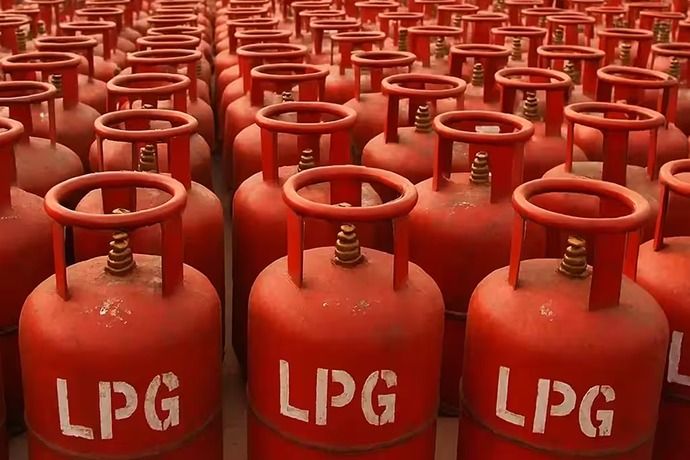

Liquefied Petroleum Gas (LPG) is a mixture of light hydrocarbons—principally propane ($C_3$) and butane ($C_4$)—recovered from natural gas processing and crude oil refining. It is stored and transported as a liquid under moderate pressure and returns to the gaseous phase at atmospheric pressure, giving a volume ratio of roughly 250 to 1 in the liquid state.
The product is supplied as commercial propane, commercial butane, or a propane/butane blend adjusted to the vapour pressure required by the destination climate, in accordance with applicable EN 589, ISO 9162, or GPA 2140 specifications and subject to the refinery's Certificate of Quality and independent inspection at the agreed loading point.
Product Name: Liquefied Petroleum Gas
Types: Commercial Propane, Commercial Butane, Propane/Butane Blend
Standards: EN 589 / ISO 9162 / GPA 2140
HS Codes: 2711.12–2711.19
UN Numbers: UN 1075 / UN 1978 / UN 1011, Class 2.1
Appearance (Liquid Phase): Clear, colourless, free of water and sediment (Visual)
Odour: Odorised with ethyl mercaptan, detectable at 1/5 LEL (ASTM D6273)
| Parameter | Unit | Commercial Propane | Commercial Butane | Test Method |
| Composition | ||||
| Propane Content ($C_3$) | % v/v | Min. 95.0 | Report | ASTM D2163 / ISO 7941 |
| Butane Content ($C_4$) | % v/v | Report | Min. 95.0 | ASTM D2163 / ISO 7941 |
| $C_2$ and Lighter (Ethane) | % v/v | Max. 2.0 | Max. 2.0 | ASTM D2163 |
| $C_5$ and Heavier (Pentanes Plus) | % v/v | Max. 2.0 | Max. 2.0 | ASTM D2163 |
| Olefins (Propylene / Butylene) | % v/v | By agreement, report | By agreement, report | ASTM D2163 |
| Dienes (incl. 1,3-butadiene) | % mol | Max. 0.5 | Max. 0.5 | EN 15470 / ISO 7941 |
| Volatility & Density | ||||
| Vapour Pressure (gauge) @ 40°C | kPa | Max. 1 550 | Max. 520 | ISO 4256 / ASTM D1267 |
| Volatility - 95% Evaporated Temp. | °C | Max. -38.3 | Max. +2.2 | ASTM D1837 |
| Density @ 15°C (Liquid Phase) | kg/m³ | 500–520 (typical) | 570–585 (typical) | ISO 3993 / ASTM D1657 |
| Gross Calorific Value (typical) | MJ/kg | $\approx$49.5 | $\approx$50.0 | ASTM D3588 |
| Purity, Corrosion & Stability | ||||
| Total Sulfur (after odorisation) | mg/kg | Max. 50 | Max. 50 | ASTM D6667 / EN ISO 20846 |
| Hydrogen Sulfide | - | None (negative) | None (negative) | ASTM D2420 / EN ISO 8819 |
| Copper Strip Corrosion (1 h @ 37.8°C) | Rating | Class 1 | Class 1 | ASTM D1838 / ISO 6251 |
| Residual Matter (Oil residue on evap.) | ml/100 ml | Max. 0.05 | Max. 0.05 | ASTM D2158 |
| Evaporation Residue | mg/kg | Max. 60 | Max. 60 | EN 15470 |
| Free Water Content | - | None | None | Visual |
| Dryness (Moisture) | - | Pass valve freeze test | Pass valve freeze test | ASTM D2713 |
| Fluorides, Chlorides & Other Halides | - | None detectable | None detectable | By agreement |
| Grade | Key Requirement | Typical Use | UN Number |
| Commercial Propane | Min. 95% $C_3$ | Heating, cooking, industrial burners, cold climates, cylinder and bulk supply | UN 1978 |
| Commercial Butane | Min. 95% $C_4$ | Cylinder supply in warm climates, aerosols, lighter fuel, industrial use | UN 1011 |
| Propane / Butane Mix | By agreement (e.g., 30/70, 50/50, 70/30) | Blended to the vapour pressure required by the destination climate | UN 1075 |
| Autogas (EN 589) | Min. 89 MON, dienes max. 0.5% mol | Automotive LPG for spark-ignition engines; four climatic grades A to D | UN 1965 |
Applications: Domestic cooking and heating, cylinder and bulk distribution, industrial burners and kilns, petrochemical feedstock, autogas for spark-ignition vehicles, agricultural drying, and off-grid power generation.
Quality Control: Every parcel is covered by a refinery Certificate of Quality issued against the listed test methods. Quality and quantity are verified at the agreed loading point by an independent inspector (SGS, Intertek, Saybolt, or Bureau Veritas).
Measurement: Quantities are determined by tank gauging or metering and corrected to 15°C per ASTM D1250 / API MPMS Chapter 14. Pressurised parcels are measured in metric tonnes rather than barrels.
Safety & Handling: Classified as UN 1075/1978/1011, Class 2.1 (flammable gas). Store in approved pressure vessels fitted with relief valves. Never fill above 85% of capacity to allow for liquid thermal expansion.
Ventilation: LPG vapour is heavier than air and accumulates in low points, basements, and trenches. Storage and transfer areas must be ventilated at ground level, bonded and earthed, and kept free of ignition sources.
Safety Data: A full Safety Data Sheet compliant with Regulation (EC) No 1907/2006 (REACH) is supplied with every cargo.